

“I knew the word wasn’t wrong, but it didn’t fit the context…”
Haruto is the owner of a small tech start-up. He needed to write an email to the CEO of another company that included the noun “money”. But something didn’t sound right. Haruto read the sentence aloud to himself:
- While your proposal sounds intriguing, our company doesn’t have the money for a project of this magnitude.
“Technically, the sentence was fine,” Haruto recalled. “But I didn’t like the tone. The word ‘money’ sounds too casual, or maybe even crude. It also sounds like our company is struggling. But we’re doing fine for a small start-up. So I need to protect our company’s reputation.”
Finding the right noun is a common writing problem. Two nouns can mean almost the same thing. However, one might sound more casual and conversational, while the other noun sounds more formal or academic.
Need Editing and
Proofreading Services?

Different nouns for different contexts
Let’s say you’re making weekend plans with a close friend. It would sound odd if you asked them, “Do you want to see a motion picture?”
Your friend’s response will likely be something like this: “A motion picture? You mean, a movie?”
But “motion picture” is fine if you’re writing a business report about a large media conglomerate: “In 2024, the company’s motion picture division generated over $4 billion.”
The situations described above highlight an important part of mastering English: choosing nouns that match the tone of your situation.
Below you will find 30 examples of everyday English nouns. To your left, you’ll find nouns for casual, everyday writing and speech. The nouns on the right are better for more formal contexts.
| Everyday Noun | More Formal Alternative |
|---|---|
| Books | Literature |
| Boss | Manager, Supervisor |
| Brother/Sister | Sibling |
| Bug | Insect |
| Car | Vehicle |
| Cat | Feline |
| Clothes | Attire |
| Cook | Chef |
| Cop | Police officer |
| Customer | Client |
| Doctor | Physician |
| Dog | Canine |
| Drink | Beverage |
| Driver | Motorist |
| Food | Cuisine |
| House | Residence |
| Husband/Wife | Spouse |
| Kid | Child |
| Lawyer | Attorney |
| Mistake | Error |
| Money | Funds, Resources |
| Movie | Film, Motion Picture |
| Person | Individual |
| Question | Inquiry |
| Shoes | Footwear |
| Singer | Vocalist |
| Situation | Circumstance |
| Teacher | Educator |
| Thing | Item |
| Worker | Employee, Team Member, Associate, Staff Member |
When should you use formal nouns?
As we saw earlier with our “motion picture” example, formal doesn’t always mean better. If you aren’t sure whether you should use a formal or casual noun, ask yourself:
- Who is my audience? (We have a whole article to help you with that–just click here!)
- What is my purpose/context?
Of course, this article doesn’t have room for every possible context. But this infographic can help. It covers ultra formal writing, ultra casual writing, and everything in between!
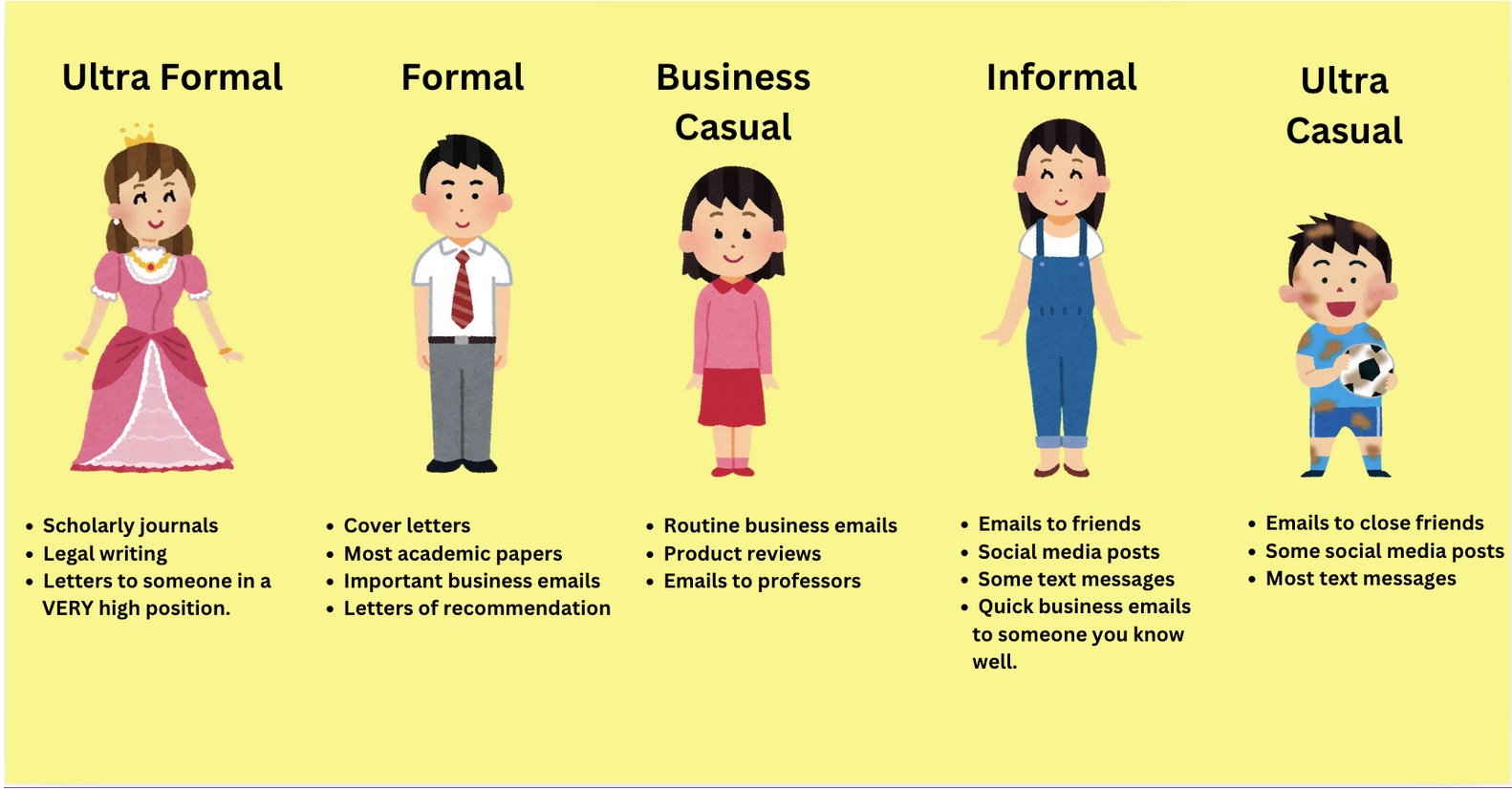
We also have a couple of TextRanch blog articles that can show you how to adjust your writing to fit different contexts.
- Click here for an overall look at formal vs. informal writing.
- This article explores the differences between casual English and academic English.
So, what about Haruto’s email? What word should he use in place of “money”? In many contexts, the noun “funds” would work. It sounds more formal and less direct than “money”.
Unfortunately, “funds” isn’t right for Haruto. Because he doesn’t want the CEO of that other company to think that his company is struggling, he decided to use the noun “resources”:
- While your proposal sounds intriguing, our company doesn’t have the resources for a project of this magnitude.
“I like ‘resources’ because it’s vague,” said Haruto. “It can mean money. Or it can mean other things, like people or equipment. The main thing is, it doesn’t make us sound like some poor, struggling company.”
Need Editing and
Proofreading Services?
Haruto found the right noun for his business email. But if you’re still unsure about the words you’re using, our TextRanch editors can help. We can let you know if your wording sounds too formal, too casual, or just right. It’s always a good idea to leave a note that explains your particular situation.
Click the blue button below and choose the editing option that’s right for you.
Do you know of any other examples of everyday nouns with more formal alternatives? Feel free to share them in the comments!


Ask an Editor: A New TextRanch Feature!
Proofreading vs. Editing: What’s the Difference?
Human Editors: Why Do You Need One?
How can I improve my understanding of native-English speakers? Part 1