

Scaling an SEO agency is an exciting journey. You go from a handful of clients to a dozen or more, your team grows, and your content output multiplies. However, with this growth comes the critical challenge of maintaining a unique, consistent editorial voice for every single client.
When you only had three clients, it was easy for your small team to remember that Client A is witty and informal, Client B is authoritative and academic, and Client C is warm and empathetic. But as you onboard your 10th, 15th, or 20th client, that mental juggling act becomes close to impossible.
Without a robust system in place, brand voices start to blend together. Content becomes generic, losing the distinct personality that helps it connect with its target audience. This is a major problem, as a consistent voice is essential for building brand trust and authority. The good news is you can scale your agency without sacrificing quality. It just requires a deliberate and systematic approach to voice consistency.
Need Editing and
Proofreading Services?

Why voice consistency becomes harder as your client count grows
The challenge of maintaining a consistent voice intensifies with scale for several reasons. First, there’s the cognitive load on your writers and editors. It’s a recipe for burnout and error to expect a single writer to switch seamlessly between a playful B2C brand and a formal B2B enterprise client multiple times a day. The subtle rules, preferred phrases, and specific tones for each client become a blur.
Second, team growth and turnover introduce new variables. Every new writer or editor brings their own habits and style. Without clear, objective guidelines, their personal voice can unintentionally creep into client work, diluting the established brand identity. Also, when an experienced team member leaves, their institutional knowledge of a client’s voice often leaves with them, forcing you to start from scratch.
Lastly, the sheer volume of content makes manual oversight difficult. As you produce more blog posts, landing pages, and social media updates across your client roster, it gets harder for a single editor or content manager to personally review every piece for perfect voice alignment. This is when quality drift begins, and a client’s once-sharp voice becomes dull and inconsistent.
Create voice standards that survive team rotation
To combat voice drift, you need to create standards that are so clear and comprehensive that they can outlast any team member. Your goal is to document the voice, not just describe it. Vague instructions like “write in a friendly tone” are subjective and unhelpful. Instead, build a detailed style guide for each client that leaves no room for interpretation.
A powerful tool for this is a set of tone sliders. Rather than just saying “professional,” you can define the voice on a scale, such as Formal 1-2-3-4-5 Casual, or Serious 1-2-3-4-5 Playful. This gives writers a concrete target to aim for.
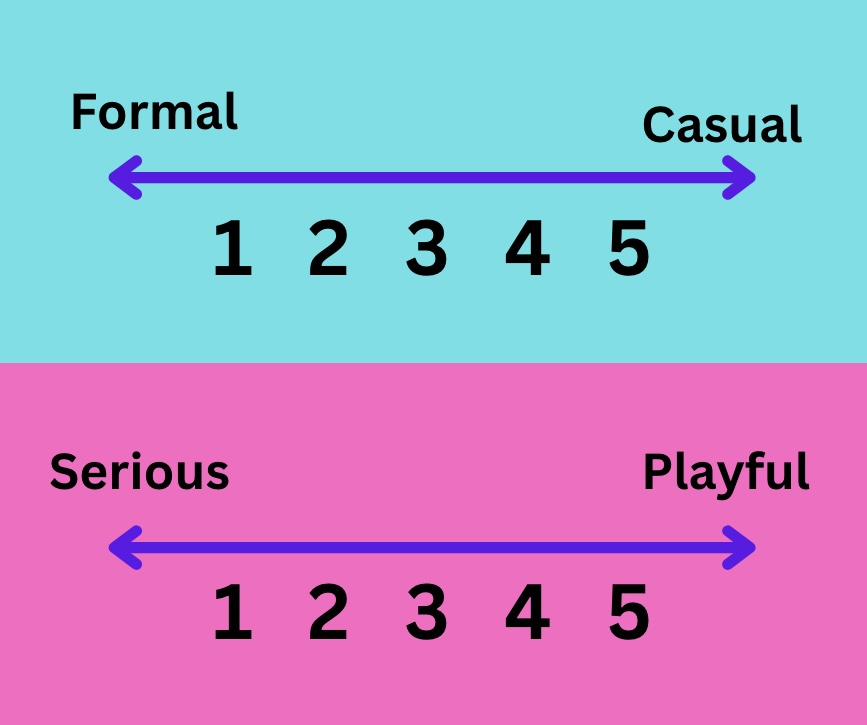
Your style guide should also include a list of banned words and phrases. These are often industry clichés or terms that clash with the brand’s identity. For example, a cutting-edge tech client might ban phrases like “in today’s digital age” or “synergistic solutions” to avoid sounding like every other competitor.
Most importantly, provide style snapshots. These are practical, side-by-side examples of “write like this, not like that.” Show a sentence written in a generic way, then rewrite it to perfectly capture the client’s voice. This visual comparison is often more effective than pages of abstract rules, as it makes the desired style tangible and easy to replicate.
Use editorial QA to protect brand identity
Documenting your voice standards is the first step, but enforcing them is what truly protects your clients’ brand identities. This requires a dedicated quality assurance (QA) process that’s focused specifically on voice and tone.
Implement pre-publish voice checks as a non-negotiable part of your workflow. This means that before any piece of content goes live, an editor who wasn’t the original writer reviews it. Their primary task is to check for grammar and spelling, but to also ask, “Does this sound exactly like the client?” This dedicated review step acts as a crucial gatekeeper, ensuring that only on-brand content reaches the public.
Equally important are post-publish feedback loops. The QA process shouldn’t be a silent one. After a piece is reviewed, the editor should give the writer specific, constructive feedback. Instead of just making changes, they should explain why a certain phrase was adjusted or why a particular paragraph didn’t align with the client’s voice. This continuous feedback helps writers internalize each client’s unique style, reducing the need for heavy edits over time and empowering them to produce on-brand content from the first draft.
Prevent quality drift among multilingual or global teams
As agencies grow, they usually build talented teams with writers from around the world. While these writers may have an excellent command of English grammar, they can sometimes use phrasing or idioms that sound slightly unnatural to a native speaker. This isn’t about right or wrong; it’s about the subtle nuances that make writing flow smoothly and authentically for a specific audience.
This is where quality drift can be especially subtle. The content might be grammatically perfect and follow the style guide, but it may lack the final layer of cultural and linguistic polish that makes it truly resonate with the target audience. Automated grammar checkers are completely blind to these issues, as they can’t understand context, cultural nuance, or the subtle rhythm of natural language.
To solve this, it’s essential to incorporate a native review for the final polish. This final check by a native English speaker is designed to catch awkward phrasing, misused idioms, or sentences that are grammatically correct but just sound “off”. This step ensures the content is accurate and on-brand, reading with the effortless clarity and authenticity that builds reader trust.
Add TextRanch as the final voice consistency layer
Implementing a native-speaker review for every piece of content can be a logistical challenge, particularly when your internal editors are already at full capacity. This is where an external partner can become an invaluable part of your QA process, acting as the final, objective layer of quality control. When you need to scale your editing capabilities without overstretching your team, a human-powered editing service provides the perfect solution.
This approach allows you to guarantee that every article, email, and report gets a final polish from a professional who understands the subtleties of the English language. For agencies looking to implement this final check without hiring more full-time staff, using TextRanch editing support for agencies serves as a flexible, reliable solution. Our team of native-speaking editors can quickly review content for clarity, tone, and natural flow, making sure your client’s voice remains consistent and professional, no matter who wrote the initial draft.
Need Editing and
Proofreading Services?
Consistency scales when quality control is explicit
Maintaining a distinct voice for over 10 clients isn’t magic; it’s the result of intentional systems and processes. You can’t leave brand identity to chance or assume your team will just “get it.” Consistency only scales when quality control is explicit, documented, and enforced.
By creating detailed style guides, implementing rigorous QA checks, and adding a final layer of professional review, you can build an editorial machine that produces high-quality, on-brand content every time. This systematic approach protects your clients’ identities, empowers your team, reduces errors, and ultimately allows your agency to grow with confidence.


Ask an Editor: A New TextRanch Feature!
Proofreading vs. Editing: What’s the Difference?
Human Editors: Why Do You Need One?
How can I improve my understanding of native-English speakers? Part 1